Why Speed Matters in Research Commercialisation




Why Speed Matters in Research Commercialisation
Alastair Hick · 16 October 2026
Australia's research commercialisation system is too slow, and the main reason is that we don't treat time as something valuable.
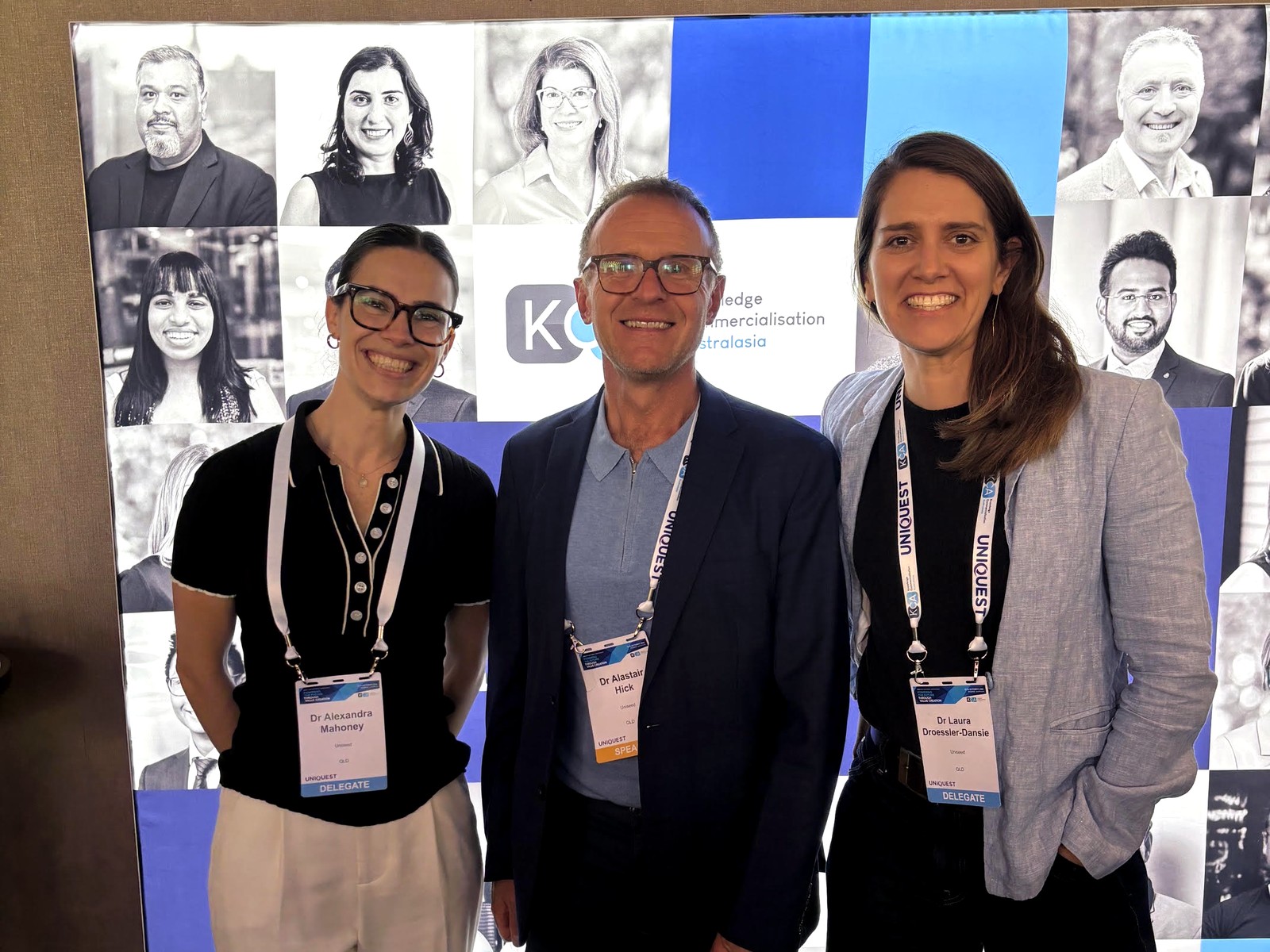
That was the argument I made at the Knowledge Commercialisation Australasia conference in Brisbane, where I joined a panel asking a simple question: if you could change one thing about how we commercialise research and spin out new companies, what would it be? There are plenty of worthwhile answers. Mine was speed.
We don't value anyone's time
Every stage of the process is slower than it needs to be: getting from a promising piece of research to a disclosure, from a disclosure to a licence, from a licence to a term sheet, and from a termsheet to a company that can actually start work. Delay isn't caused by any one party. It comes from a system in which nobody treats time as a cost.
That applies to everyone involved:
Colleagues' time: Technology transfer offices, legal teams and investment teams are all finite. When a deal drags, the hours spent re-explaining, re-negotiating and chasing are hours not spent on the next opportunity.
Investors' time: Every deal that takes months longer than it should crowds out others. More demand and more deals against the same-sized team means the queue only gets longer.
Researchers' and founders' time: Academic founders are often working part-time on the venture while carrying a research load, and many are doing this for the first time. Waiting for the process to catch up with them is expensive in energy, in good will and in momentum.
A technology's value shrinks while we wait
The cost of delay isn't only measured in hours. A technology is not a fixed asset that sits waiting for us to get around to it. Its value falls over time, because the rest of the world keeps working. Research groups elsewhere publish, competitors raise capital and hire, and a lead that looked decisive at the point of disclosure can be gone by the time a company is formed.
This matters more in Australia than in most places. Our domestic market is small, and our access to talent and capital is finite. We can't afford to burn the head start our researchers have earned, and we have far less room than larger systems to absorb a slow start and still catch up.
What changes when time has a price
Speed doesn't mean cutting corners. It means treating elapsed time as a cost that someone has to account for. If we did that, the questions we ask at every stage would change. Beyond "is this the right deal?", we would also ask how long it has been waiting, what that wait is costing, and who is paying for it.
Those costs fall on different people, which is part of why they go unnoticed. The university, the investor and the founder each see only their own share of the delay, so no one has a reason to fix the whole. A system that valued time would make that total cost visible to all three.
It needs a shift in mindset
Changing the process won't be enough unless the mindset behind it changes first. Today, a slow deal is treated as normal, even as a sign of diligence. We need to move to a view where speed is part of doing the job well, and where every party accepts that taking longer has a real price, paid by someone else if not by them.
That includes getting to "no" quickly, as well as "yes". A fast "no" is a good outcome. It frees researchers and founders to find another path, and it frees investors and universities to put their time into opportunities that can go ahead. The worst outcome is a deal that lingers for months and ends in a "no" that could have been given at the start.
Where we go from here
Slowness is not a law of nature. It is the sum of many small decisions to let things wait, and each of us can decide differently. At Uniseed we are used to taking risk, but delay is a risk with no upside. That is why I am co-chairing, with Michael Lamprecht of Tenmile, the Roundtable Working Group behind Bridging the Gap, a draft white paper on IP licensing for spinout formation inAustralia and New Zealand. It brings investors, technology transfer professionals and founders to the same table, sets out each party's reasoning on the terms that most often stall a deal (equity, milestones and royalties, governance, and conflicts of interest), and offers indicative ranges to shorten the distance between opening positions and a signed licence. The aim is a spinout that can be licensed and incorporated in weeks rather than quarters.
A paper alone won't change anything. The system has to use it. So here is my challenge to everyone in it. Treat time asthe scarce resource it is. Ask what each week of delay costs and who is paying for it. Say "no" early when the answer is no, and move on"yes" as though the clock is running, because it is. If you are a researcher, a university colleague or an investor, read the draft, test it against your own deals and tell us where it falls short. We want to hear from you.
More Stories to Explore